SPECIAL EDITION! South Caucasus Brief: Turkey–Azerbaijan Rift
The South Caucasus Brief is a monthly update from ISA, a research institute based between Washington, D.C. and Yerevan. Now more than ever, stakeholders need clarity and cohesion when it comes to South Caucasus policy. In this newsletter, ISA’s experts provide personal observations and analysis on overlooked developments reshaping the region. We hope you find it useful, but if you would like to opt out at any time please do so via the unsubscribe button below.
Welcome back to ISA’s South Caucasus Brief.
The special highlight this week: A deep dive into the headscarf row roiling Turkish–Azerbaijani relations — and Turkey’s broader reckoning with Baku’s growing sway.
Leading this week
The Turkey–Azerbaijan strategic partnership is often taken at face value. The Turkic duo’s intimate relationship — rooted in shared economic interests and cultural affinities — is often captured by the slogan “one nation, two states.” Within this context, mainstream commentary often portrays Azerbaijan as a junior partner, and in some cases, a proxy of Turkey. But this is a gross mischaracterization.
Over the last decade, this partnership has swung firmly in Azerbaijan’s favor; Baku has accumulated significant leverage vis-à-vis Ankara. Its asymmetric, often pernicious sway is an open secret within Turkey’s political establishment but has recently spilled into the public sphere. This month’s row — centered on Azerbaijan’s headscarf ban — has precipitated a broader reckoning in Turkey over ties with its perennial ally.
This ban on religious garb has particularly struck a chord among Turkish President Recep Tayyip Erdogan’s pious base. The ruling AKP and its conservative predecessors waged a sustained struggle against Turkey’s longtime secular establishment to lift headscarf restrictions. The rift has compounded already palpable angst around Azerbaijan. Baku’s intimate ties with Israel have rankled Turkey’s ardently pro-Palestinian public. (Azerbaijan supplies an estimated 40 percent of Israel’s crude oil via Turkey’s Ceyhan port.) And Israel’s increasingly aggressive posturing vis-à-vis Turkey has raised doubts around Azerbaijan’s allegiances.
This surge in cross-border criticism has riled Azerbaijan’s thin-skinned authorities. In typical fashion, Azerbaijan dispatched its disinformation apparatus to pursue critics. Azerbaijan also blacklisted 31 Turkish citizens of various political stripes. The targets ranged from hardline Islamists Mehmet Boynukalin and Yahya Ugras to MP Omer Faruk Gergerlioglu, a deputy from the pro-Kurdish DEM Party. (Gergerlioglu, known for his human rights advocacy, has previously condemned Azerbaijan’s regional conduct.)
(Declaring perceived opponents persona non grata is a favorite pastime of Baku. In years past, Azerbaijani authorities routinely barred foreign nationals for visiting Nagorno-Karabakh.)
According to reports, Azerbaijan is particularly incensed with Hakan Fidan, Turkey’s powerful foreign minister. Azerbaijani media outlets accused the minister of plotting to interfere in the country’s domestic affairs. (Fidan previously served as Turkey’s longtime intelligence chief and is frequently touted as a potential successor to Erdogan.)
On October 25, the spiraling row appeared to enter a lull; Erdogan folded. The Turkish leader sacked Oktay Saral, a chief presidential adviser. Commentators across the political spectrum rushed to charge Azerbaijan with interfering in Turkey’s internal affairs. (Absolute sovereignty remains sacrosanct in Turkish politics.) The extraordinary concession drew the ire of AKP cadres — and left Erdogan exposed. His deference bruised his strongman persona while confirming Baku’s superior position in the bilateral relationship.
Photo of the week
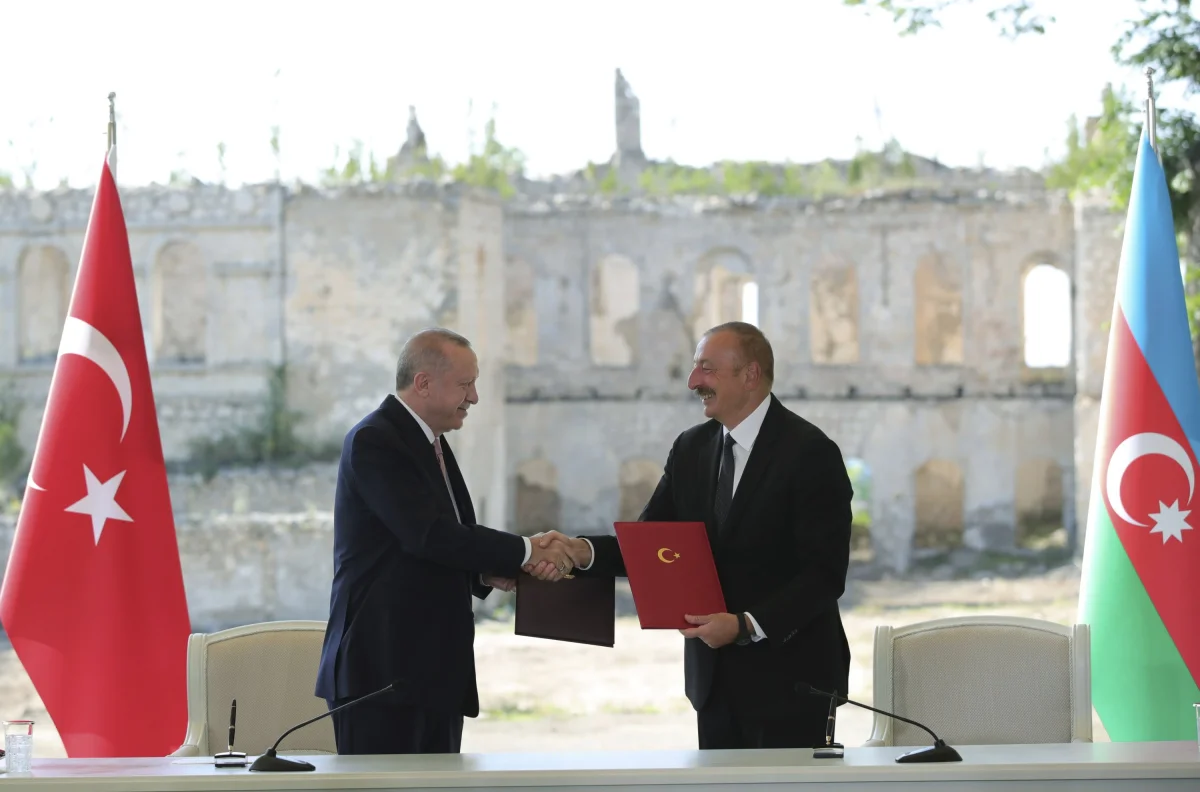
Azerbaijani President Ilham Aliyev and Turkish President Recep Tayyip Erdogan shake hands after signing the “Shusha Declaration” in Shushi, Nagorno-Karabakh, on June 15, 2021. (AP Photo)
Leading this week (continued)
Despite Erdogan’s concession, the crisis continues unabated. Baku is not satisfied and, perhaps sensing weakness in Ankara, is out for blood. Azerbaijan is ratcheting up rhetoric, issuing thinly-veiled warnings to Turkey. During a recent speech, Azerbaijani President Ilham Aliyev admonished his Turkish counterparts: “Before doing this [criticizing], you should look in the mirror. You should ask yourself whether you have the right to give lessons to anyone.” Hikmet Babaoglu, a ruling party deputy, echoed his boss’s sentiments: “They should think twice before speaking against Azerbaijan in Türkiye.” This torrent of verbal abuse is perhaps part of a broader gambit to extract further concessions from Ankara.
This charged rhetoric also serves as fodder for influence operations. Baku is casting the row as a showdown with Turkey’s Islamists — seeking to score points with Tel Aviv and Washington. Azerbaijan deftly manipulates geopolitical incidents to reshape perceptions of regional affairs. (Russia and Azerbaijan routinely stage tensions to mislead Western audiences.) This image-peddling campaign comes amid the looming resumption of the conflict around Iran.
With the ante up, Erdogan is striving to assuage Aliyev’s concerns. Turkish authorities are rounding up critics, allegedly at Azerbaijan’s behest. Many are facing charges of “insulting a foreign head of state.” (Erdogan is trying to placate Aliyev — cajoling him to attend the upcoming Organization of Turkic States summit in Ankara, so far to no avail.)
Among the detainees is religious activist Muhammed Emin Yildirim, who was blacklisted from Azerbaijan. The detention drew criticism from religious groups, including Islamist politician Fatih Erbakan, who accused Erdogan of yielding to Aliyev. (His late father, former Prime Minister Necmettin Erbakan, served as Erdogan’s political mentor.) Upon his release, an undeterred Yildirim took to social media to double down on his criticism of Azerbaijan.
Amid the lingering standoff, Devlet Bahceli, an Erdogan ally who leads the nationalist MHP party, is running mediation. Bahceli’s recent remarks touting mutual sovereignty were well received in Baku. Over the last decade, Azerbaijan has expanded its clout within Turkey’s nationalist camp. Reports suggest that Baku is mobilizing these networks amid the ongoing crisis, including figures such as far-right politician Umit Ozdag.
Meanwhile, the fallout from the crisis continues to reverberate across Turkish society. Azerbaijan’s conduct, including its sustained targeting of Turkey’s Islamist politicians, has ignited a fierce backlash among Erdogan’s base. AKP cadres are also clamoring for Erdogan to appoint Oktay Saral, his sacked adviser, to a new post.
Perhaps more consequentially, the rift has precipitated a reckoning over Azerbaijan’s growing influence. Across Turkish social media, there is a deluge of revelations around Baku’s past indiscretions — bouts of strategic corruption, hybrid operations and political interference. Previous instances of bilateral tension were short-lived and quickly swept under the rug. (This one may prove to be as well.)
But this latest row appears to have triggered a more fundamental shift in Turkish perceptions. Azerbaijan’s aggressive antics have compelled Turks to reconsider, perhaps for the first time, the logic and risks of this increasingly skewed partnership.
For seasoned observers, this crisis of confidence was years in the making — the culmination of unchecked Azerbaijani influence accumulation. Over the last decade, amid Turkey’s economic downturn, Azerbaijani largesse has helped sustain Erdogan’s political machine — and its web of patronage networks. In exchange, Aliyev received free rein to amass economic and political clout across Turkey.
Baku has maximized its privileged access to supercharge its regional ambitions, particularly in the energy sector. SOCAR, Azerbaijan’s national oil company, played a key role in transforming Turkey into an energy hub. And in the process, Baku secured significant leverage over Ankara — and the European Union. (SOCAR Turkey serves as a linchpin of Azerbaijan’s influence networks in Ankara.) Turkey has also provided a springboard for SOCAR — and, by extension, Azerbaijan — to foray into Europe’s eastern flank.
Azerbaijan has also pimped Turkey to burnish its strategic value vis-à-vis Moscow. For the Kremlin, Baku serves as a geopolitical fixer, opening Turkey to Russian economic and political networks. Against this backdrop, Turkey has emerged as a staging ground for Russian grey-zone operations. Azerbaijan is also leveraging Turkish infrastructure to launder Russian oil. (The Izmir-based Star Oil Refinery is a major conduit for Russian fuel entering the European Union.)
Azerbaijan and Russia, often characterized as “one elite, two states,” have also coordinated efforts to steer Turkey toward the Eurasianist, anti-Western geopolitical camp.
During high-stakes Turkish presidential polls in 2023, Baku, along with Moscow, decidedly intervened to float their favored candidate. The authoritarian duo rolled out a bag of tricks to improve Erdogan’s electoral prospects — delayed debt repayments, media manipulation and outright political intervention. (According to observers, Aliyev played a key behind-the-scenes role in choreographing far-right candidate Sinan Ogan’s endorsement of Erdogan, which boosted the latter’s fortunes in the second round.)
For years, Erdogan reaped vital benefits from his open-door policy vis-à-vis Azerbaijan. But that was then.
His Faustian bargain has since backfired, turning a once-lucrative partnership into a strategic liability. The geopolitical irony is cruel: Turkey lavished Azerbaijan with diplomatic cover, energy markets and defense kit — all of which expanded Baku’s regional reach and margin of maneuver. In the process, Azerbaijan gathered outsized clout from Central Asia to Europe — and unprecedented leverage over Turkey itself.
With the balance of power tilted in its favor, Baku is now pressing its advantage. Aliyev is wielding leverage bestowed by Erdogan to set new rules of engagement and cut Turkey down to size. A cautionary tale of a patron turned hostage.