Welcome to the South Caucasus Brief, a monthly update from the Institute for Security Analysis. Now more than ever, stakeholders need clarity and cohesion when it comes to South Caucasus policy. In this newsletter, ISA’s experts provide personal observations and analysis on overlooked developments reshaping the South Caucasus.
Leading this month
Economic disinformation is rife in the South Caucasus — particularly in Armenia. A lack of reliable data, coupled with corruption and limited transparency, has created fertile ground for sustained disinformation. Actors often deploy specious narratives to distort geopolitical discourse and mask strategic dependencies. (Economic subjugation is routinely portrayed as symbiotic cooperation.) Amid Armenia’s upcoming elections, economic disinformation is surging across the campaign trail.
On April 1, during a theatrical tête-à-tête with Armenian PM Nikol Pashinyan, Russian President Vladimir Putin claimed that Armenia receives discounted access to Russian gas compared to European countries. Putin said: “Gas prices in Europe exceed 600 dollars per 1,000 cubic meters, whereas Russia provides gas to Armenia at 177.5 dollars per 1,000 cubic meters. The disparity is vast, the difference is substantial.”
Yet credible experts dismissed the Kremlin’s remarks. According to a well-placed source, there is speculation that Armenia pays more than the official rates. Russia has employed similar financial engineering tactics in Moldova and Ukraine. Other observers rejected claims of preferential access, arguing that such framing masks Russia’s longstanding efforts to cultivate structural dependency. Moscow supplies roughly 86 percent of Armenia’s gas. And the country’s gas distribution network is owned by Russia’s Gazprom — a legacy of former Armenian President Robert Kocharyan. (Despite Armenia’s alleged westward pivot, the Pashinyan administration has neglected to wean itself off Russian energy.)
Putin’s remarks aim to reinforce Russia’s importance in the Armenian psyche — highlighting its alleged benevolence while portraying Moscow as indispensable to Armenia’s energy security. The narrative also seeks to discourage Armenian audiences from pursuing deeper engagement with foreign partners by framing diversification as futile. (Moscow previously sabotaged Armenia’s efforts to expand gas imports from neighboring Iran.)
Another frequent subject of disinformation is the so-called “Trump Route for Peace & Prosperity” (TRIPP), alternatively known as the Zangezur Corridor. On the campaign trail, Armenian authorities — eager to justify concessions vis-à-vis Azerbaijan — tout the corridor as a pathway to economic revival and regional integration. During a recent lunch with Armenia’s business community, Pashinyan urged local companies to utilize the TRIPP-linked Armenia–Azerbaijan railway. But despite the lofty rhetoric, Armenian authorities have yet to clearly articulate the tangible economic benefits of normalization — and of TRIPP in particular.
Closer analysis suggests far more limited — and potentially adverse — outcomes. Experts suggest TRIPP’s commercial potential is exaggerated. (Despite years of effort, neighboring Georgia has yet to reap significant dividends from its stretch of the Middle Corridor.) The initiative also lacks detailed planning, while primarily facilitating Azerbaijani connectivity with Turkey, offering only marginal economic returns to Yerevan.
TRIPP also risks deepening structural dependencies. The nascent corridor embeds Armenia within logistics networks shaped by Russian and Azerbaijani interests, while sidelining alternative routes — particularly links with Iran and Georgia. (Contrary to popular narratives, TRIPP enjoys Russian support.) When these factors are considered, TRIPP appears more like a gambit to reframe geopolitical concessions as mutually beneficial cooperation, rather than a vehicle for economic transformation.
Amid weak analytical capacity in the South Caucasus, economic myths — once rooted — are increasingly difficult to dislodge. One dogged myth centers on Armenia’s recent economic track record. Since assuming power in 2018, the Pashinyan administration has frequently pointed to robust growth rates as evidence of effective economic stewardship. Yet closer inspection suggests this narrative is specious: Armenia’s performance has been shaped in large part by favorable external dynamics rather than structural reform. And in recent years, sanctions evasion activities have driven economic growth.
Despite the diminished sovereignty of Armenia, Russia continues to extract strategic value from the country, particularly as a hub for economic activity. In a 2024 interview, Dimitri Trenin, a Kremlin insider and former director of the Carnegie Moscow Center, affirmed Russia’s strong interest in expanding economic ties with Armenia. Amid a partial decoupling with the West, Russia has prioritized securing access to friendly markets. Armenia — along with Azerbaijan, Georgia, and Turkey — have emerged as key nodes in Russia’s sanctions evasion infrastructure. (MP Khachatur Sukiasyan, a Pashinyan ally and prominent oligarch, plays a key role in Russian sanctions-busting networks. His firms have facilitated the laundering of Russian gold via the United Arab Emirates.)
While Armenia continues to serve as a sanctions evasion hub — primarily as a conduit for technology, precious metals and increasingly financial flows— the European Union has been hesitant to respond forcefully, preferring quiet, backchannel warnings. Diplomats fret that stronger measures could undermine economic growth and disrupt the ruling party’s electoral prospects. That restraint, however, appears to be waning. Armenia’s Unibank is facing EU sanctions. And the post-election period is likely to bring increased pressure to curb sanctions-evasion activity.
What we are watching
Election interference. Armenian voters are heading to the polls in high-stakes parliamentary elections on June 7. The outcome is poised to reshape the country’s geopolitical and domestic trajectories. The vote is also accompanied by a constitutional referendum, with proposals to remove language long contested by Azerbaijan — particularly references to Nagorno-Karabakh. Amid the high-stakes contest, a slew of domestic and foreign actors (i.e., Russia and Azerbaijan) are maneuvering to influence the result.
According to seasoned observers, the recent Pashinyan–Putin brawl served to boost the former’s electoral fortunes. (Russia often stages tensions with Armenia — and Azerbaijan— to mislead Western audiences.) Choreographing rows follows a standard playbook: a widely publicized rhetorical escalation is followed by a return to the status quo — with no meaningful policy shifts. (Previously, Yerevan and Moscow exploited feigned tensions around the former’s threatened CSTO withdrawal to manipulate domestic audiences and international stakeholders.)
And just like clockwork, tensions evaporated within days of the Kremlin showdown. A stalwart of the ruling party, Ruben Rubinyan, even downplayed the episode: “As you can see, no catastrophe has occurred. Russia is a friendly country to us, and we continue our friendly relations.” Yet the episode served its purpose — the exchange generated a wave of headlines burnishing Pashinyan’s anti-Russian credentials.
Azerbaijan is also playing a major role in shaping the electoral cycle. Its influence networks within Armenia and the West — alongside state officials— have championed Pashinyan’s candidacy, deploying sophisticated information campaigns to bolster the prime minister’s electoral prospects. Chief among them, scare tactics.
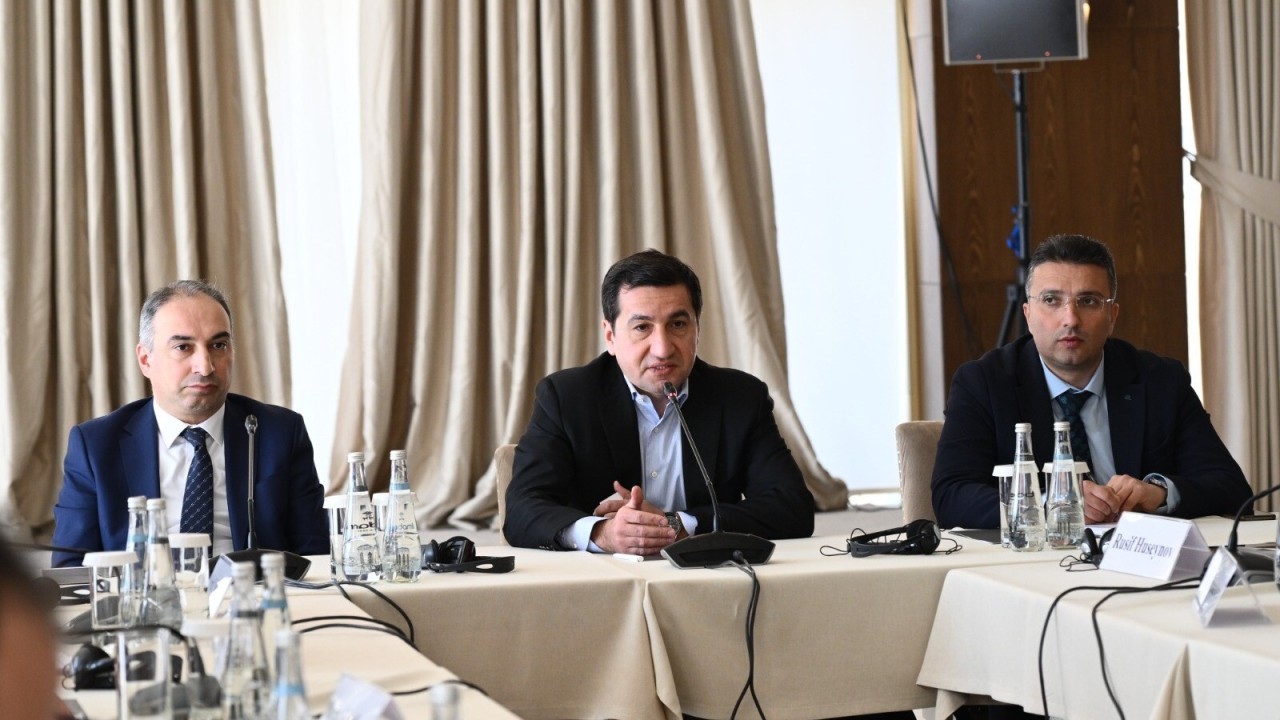
While recently addressing Armenian and Azerbaijani “civil society” members, Hikmet Hajiyev, Azerbaijan’s shadow foreign minister, declared: “The presence of revanchist forces in Armenia’s domestic political landscape, along with their calls for war, risks dragging the region back into turbulence — similar to the late 1980s and early 1990s.”
This narrative has also been picked up by Armenian politicians. While campaigning, Armenian authorities have engaged in routine scaremongering, explicitly implying that an opposition victory risks drawing Armenia into a Ukraine-like quagmire. This “pragmatic logic” — detached from reality — aims to cast the Civil Contract party as responsible stewards of the country’s geopolitical orientation.
Azerbaijani influence networks are also casting the elections — and the Armenia–Azerbaijan normalization process — as a unique opportunity to regain sovereignty from Russia. This bogus claim has been echoed by pro-government circles. A recent panel hosted by Armenian Council, a government-affiliated think tank, titled “Sovereignty or ‘Guberniya’ (Russian Province)?” illustrates how rapidly disinformation is hurled from the fringe into the mainstream.
Critics have mocked the irony of this latest information campaign. While pro-government circles bemoan Russia’s pernicious influence, they often justify concessions and losses of sovereignty vis-à-vis Azerbaijan. (This narrative also conveniently ignores the strategic partnership between Baku and Moscow.)
Foreign malign influence is warping an already vapid political landscape. The Armenian public is incensed with the traditional political class. And voter apathy has skyrocketed. This disengagement has, in turn, created fertile ground for vote buying. Reports suggest both the government and opposition are engaged in extensive electoral bribery. The continued degradation of Armenia’s political system bodes poorly for the upcoming polls — and risks squandering an opportunity for much-needed change after a decade-long cycle of crisis.
Georgia in the lurch. On April 6, Azerbaijani President Ilham Aliyev touched down in Tbilisi for a state visit. The whirlwind tour featured various high-level engagements, including meetings with Georgian Prime Minister Irakli Kobakhidze and Bidzina Ivanishvili, Georgia’s de-facto leader. (Prior to Aliyev’s arrival, Georgian authorities deported Azerbaijani journalist Afgan Sadygov, a government critic, in an attempt to curry favor with the Azeri leader.)
During the visit, Georgian authorities offered routine platitudes around expanding bilateral cooperation across the energy and transportation sectors — while reaffirming the strategic role of Azerbaijan-linked critical infrastructure. Prime Minister Irakli Kobakhidze lauded the potential of the much-vaunted, yet still nascent, Middle Corridor. While Ivanishvili signaled Georgia’s continued openness to Azeri capital, particularly in the logistics sector. (Baku is increasingly leveraging Georgia’s Kulevi terminal to reexport Russian oil to European markets.)
Despite Aliyev’s warm reception, unease is simmering beneath the surface. The rapid reconfiguration of the region’s power politics is eroding Georgia’s once prominent role — due in part to Tbilisi’s own policy missteps. Georgian stakeholders are particularly concerned with the TRIPP corridor. (Georgia derives strategic value by serving as a land bridge connecting Azerbaijan with Turkish and European markets.) TRIPP, via new routes through Armenia, could offer shorter, more efficient transit options, undermining Georgia’s de facto monopoly on cross-regional connectivity.
Early signs of friction are already visible. In December 2025, Georgian authorities imposed steep transit fees on the first Azerbaijani fuel shipment bound for Armenia, prompting pushback from both Baku and Yerevan. The dispute was resolved only after Azerbaijan signaled it could open a direct border route with Armenia, forcing Georgia to scale back its demands. This episode highlights Georgia’s precarious geopolitical posture — and its growing deference to the whims of regional powers (i.e., Azerbaijan and Russia).
Deals and visits ✈️
- Armenian bank faces EU sanctions
- Serbia, SOCAR to build gas power plant
- Georgia expands electricity imports from Russia
- Armenia, Georgia discuss logistics coordination
- Trump Organization plans Tbilisi skyscraper with local partners
What we are reading
- Moscow expands military networks in West Africa (The Sentry)
- Russian economy is faltering despite oil windfall (Financial Times)
- How Hungary coordinates with Russia to erode EU cohesion (VSquare)
- Politics and academic freedom around the Armenian Genocide (NAASR)
- Shadow power and Iranian influence networks in Baghdad (RealClearWorld)

